Saqqara, Memphis & Dahshur Day Tour
Giza
With Voya Tours, discover the roots of ancient Egyptian civilization through an unforgettable journey to three of its most historically significant sites: Saqqara, Memphis, and Dahshur. This carefully designed day tour takes you beyond the famous pyramids of Giza and deeper into the origins of pyramid construction, royal tombs, and the first capital of ancient Egypt.
This experience is ideal for travelers who are passionate about history, archaeology, and authentic cultural discovery. Instead of focusing only on the most famous landmarks, this journey reveals the early chapters of Egyptian civilization the experimental designs, the first monumental stone structures, and the evolution of pyramid architecture that later led to the creation of the Giza Pyramids.
Tour highlights
What is included
Included
- English tour guide
- Entrance tickets
- Private car with a driver.
- 1 bottle of water
- Lunch
Not included
- Any optional activities
- Tips
Detailed itinerary
1 daysDay 01 Dahshur Day Tour
Your day begins with a comfortable pickup from your hotel in a private air-conditioned vehicle, where you will be welcomed by your professional guide. From that moment, the journey unfolds smoothly, taking you through vast desert landscapes and ancient sites that have shaped human history for thousands of years. Each stop is carefully selected to tell a deeper story about how ancient Egyptians lived, ruled, and built their eternal legacy.
What makes this tour truly unique is the connection between the three destinations. At Saqqara, you will witness the very first pyramid ever built. In Memphis, you will walk through the remains of Egypt’s ancient capital. And in Dahshur, you will explore the transition in pyramid design that led to the iconic shapes we recognize today. Together, these sites offer a complete understanding of the evolution of ancient Egyptian architecture and civilization.
Saqqara – The Birthplace of Pyramid Architecture
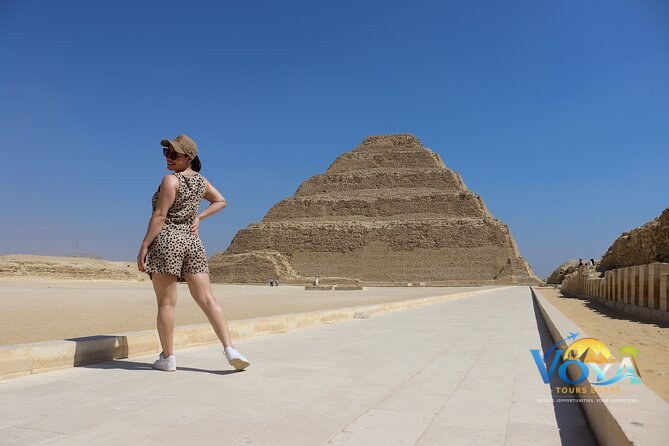
Saqqara is widely known as the birthplace of pyramid architecture and one of Egypt’s most important archaeological sites, located south of Cairo near the ancient capital of Memphis. Its heart stands the Step Pyramid of Djoser, built around 2630 BCE during the Third Dynasty and designed by the genius architect Imhotep; it is considered the world’s earliest large‑scale stone monument and the first true pyramid in history. This massive stepped structure, originally six tiers high, marked a revolutionary shift from flat mud‑brick mastabas to towering stone tombs, setting the architectural blueprint for later smooth‑sided pyramids such as those at Giza. The site also contains numerous other pyramids, royal tombs, mastabas, and sacred structures like the Serapeum, making Saqqara a vast open‑air museum that traces thousands of years of pharaonic burial practices and religious beliefs.
Memphis – The Ancient Capital
Next, you will visit Memphis was the first capital of a unified Egypt and served as the political, religious, and cultural heart of the kingdom for thousands of years. According to tradition, it was founded around 3100 BCE by King Menes (or Narmer), who combined Upper and Lower Egypt and established the city near the apex of the Nile Delta, just south of modern‑day Cairo. As the capital of the Early Dynastic Period and the Old Kingdom, Memphis housed the royal palace, major administrative institutions, and the great temple of Ptah, one of the most important centers of worship in ancient Egypt.
The city also played a key role in royal ceremonies, including coronations and the Heb‑Sed jubilee festival, and remained a major religious and economic hub even after the political capital shifted to Thebes and later Alexandria. Today, the archaeological site of Memphis and its surrounding necropolis from Giza to Dahshur form a UNESCO World Heritage area, preserving remnants of temples, colossal statues, and the memory of the ancient kingdom’s first great capital.
Dahshur – The Evolution of the Pyramids
Dahshur is often described as the open‑air laboratory where ancient Egyptian architects perfected the art of pyramid building. Located about 40 km south of Cairo, this royal necropolis was chosen by King Sneferu, the first ruler of the 4th Dynasty, to test and refine the pyramid form that would later reach its peak at Giza. The site’s most famous monuments are the Bent Pyramid and the Red Pyramid, both built under Sneferu and representing crucial steps in the transition from stepped structures to smooth‑sided pyramids.
The Bent Pyramid shows the early attempt at a true pyramid: builders initially raised it with steep sides, but midway through construction they realized the angle was too unstable and flattened the upper portion, creating its distinctive “bent” profile. Learning from this experiment, Sneferu’s architects went on to build the Red Pyramid, Egypt’s first fully successful smooth‑sided pyramid, using a more moderate slope that proved structurally sound. This architectural progress at Dahshur laid the foundation for the Great Pyramid of Khufu on the Giza Plateau, making Dahshur a key chapter in the evolution of pyramid design.
At the end of the tour, you will be comfortably transferred back to your hotel.
Frequently asked questions
Why Choose This Tour?
- Discover the origins of pyramid construction at Saqqara
- Explore the ancient capital at Memphis Witness early pyramid engineering at Dahshur Learn the full story behind the evolution of pyramids Experience quieter, less crowded historical sites
- Enjoy a deep cultural and archaeological journey Travel comfortably with a professional guide Capture unique photos away from tourist-heavy areas
How long does the tour take?
The tour usually lasts between 6 to 8 hours, depending on time spent at each site.
Is transportation included?
Yes, the tour includes hotel pickup and drop-off in a private air-conditioned vehicle.
Is a guide included in the tour?
Yes, a professional English-speaking guide is included to explain the history of each site.
Is this tour suitable for families?
Yes, it is suitable for all ages, but comfortable walking shoes are recommended
Continue exploring